essay · UNSW · March 2023
The wicked problem of HIV prevention
Sexual education and the PrEP rollout
Why HIV prevention in Australia resists a clean solution — and what politics, education, religion, economics and history each contribute to the mess.
A challenges analysis: what makes HIV prevention in Australia a wicked problem rather than merely a hard one, and where design research could actually get purchase on it.
Intro
All problems have their own aspects of complexity, but not all complexity is equal.
Some complexity exists within the scale of the problem. The problem of how to cross rivers has been solved in many different ways over thousands of years. One way is to build a bridge, and yet the complexity of building a bridge still exists today. We have gained a large amount of experience, but the scale of the task enables its complexity.
However, that is not entirely true. Building bridges is well understood. It is applying that knowledge to a specific location and set of needs in that context that creates complexity. A bridge that functions well in the heartland of America would be a rusted hulk in a year on the coast of Queensland, or shattered by the first earthquake it experienced in Japan. We already know the shape of the solution, but the hard part comes from working out how to generalise that solution to a specific location.
But how do we know we need a bridge in the first place?
What if we went back further and looked at the problem we are trying to solve? For anything to be called a solution, a person needs to be able to cross a river. We already know the shape that the solution will take. That basic foundation makes this problem exponentially simpler. Our solution is partially solved already — anything that doesn’t have a person cross the river automatically falls out of the solution space.
But what if we have a problem where we can confidently say we have no idea what actions or interventions, or even what the solution, will entail?
Bringing it back to the bridges: what if we looked at why people needed to cross that specific river? What societal, political or economic pressure drives people to need to cross? Can we solve that better without a large piece of expensive infrastructure? Would building the bridge solve the problem at heart, or are we solving a symptom of a longer-held systemic problem that would be better addressed directly?
If people need to cross the river to make enough money to support their families, why can’t they live on the other side of the river? Why can’t we promote more jobs closer to them? Or if they need to get medical attention on the other side, why can’t we build a medical centre closer to them?
If we look further out from solutions, we gain a better view of complexity and interdependencies, and get a sense of the workings that happen unseen underneath human life. Which then allows us to move back closer into the problem space to find the right problems to solve for.
Encouraging PrEP uptake in Australia
Pre-exposure prophylaxis, abbreviated as PrEP, is a drug that, when taken daily, reduces a person’s chance of contracting HIV when exposed by 99% (CDC 2022). If we could maximise the uptake of PrEP to help prevent HIV infections, we would save the Commonwealth the cost of treatment and care, which is $1 million over a person’s lifetime (AFAO 2021).
Yet not nearly enough people have access to this medicine. There are still problems with affordability, education, access and adherence, which means that people are contracting HIV who don’t have to.
As we explore this further, we’ll come to understand how politics, education, religion, economics and history combine to create the complexity found within this wicked problem.
Why is it so complicated?
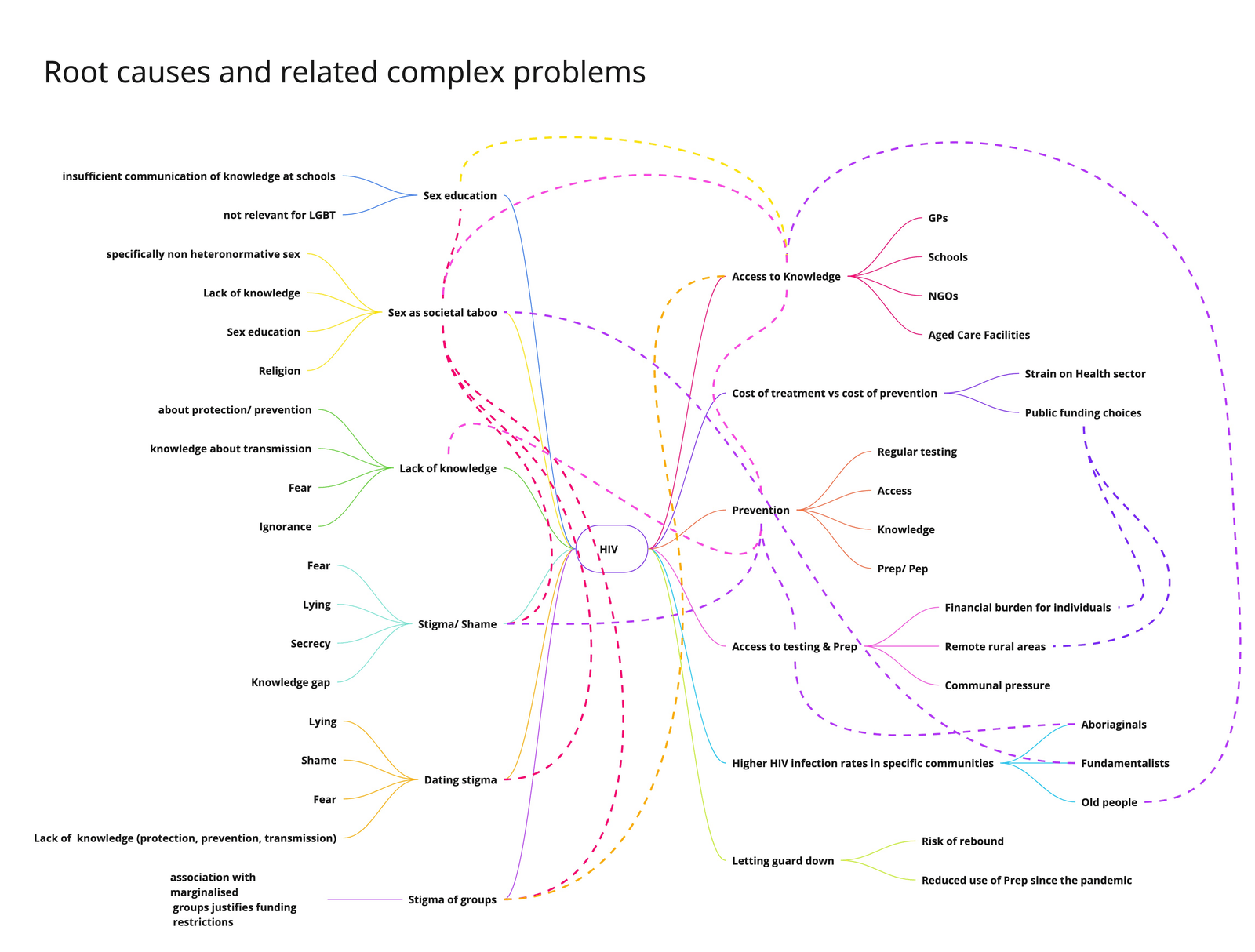
HIV cannot be seen as a neutral topic. With the history of the AIDS epidemic starting in the eighties, the politics of HIV treatment and prevention is inextricably associated with gay men and the wider LGBTQ community. Yet 27% of HIV notifications came from heterosexual sex in 2021 (AFAO 2023), an increase of 3% from 2020 (AFAO 2022). If these communities continue to believe that HIV is a virus that doesn’t affect them, then infections will continue to rise, and lives that could have gone unaffected will be unnecessarily damaged.
It is hard for the general population and key decision-makers to understand that HIV is a risk to everyone, not just men who have sex with men. A lot of this resistance stems back to the start of the AIDS epidemic and the moralistic sentiments and homophobia that slowed the initial response to the virus (Halkitis 2012). Within the general population these sentiments have largely lost favour, and yet in many ways there isn’t a political will to engage with such a potentially charged area. Consider the recent religious discrimination bill, and the continuing dragging of trans kids into the political spotlight for short-term political gain. There is a risk that larger sweeping changes in policy around funding, education and prevention could garner the same kind of vitriolic attack from conservative communities.
Then there’s education. Interacting with the historical and cultural baggage of HIV is the lack of effective and consistent education in schools about HIV prevention, and about sex in general. There is little certainty that material, even when mandated, is taught properly or beyond an abstinence-only biased model (Jones & Mitchell 2014). Which means the responsibility to find information and make informed decisions around safer sex falls to the person themselves.
In Australia and NSW, advertising takes up a large part of the job of patching the holes in how we educate young people about HIV — partly led by ACON’s Ending HIV campaign, which continues to bring basic information about HIV, regular testing, undetectable viral loads, monkeypox vaccines and PrEP out into communities that would not have had ready access otherwise.
Yet even though ACON and organisations like it do incredible work, there is a limit to what second-party sources of information and education can achieve. They are really a stop-gap to reduce the harm caused by ineffective policy around sexual education — especially when considering culturally and religiously diverse communities where free and open discourse on queer education is itself contested.
And economic access. Through the introduction of PrEP into the Pharmaceutical Benefits Scheme, the cost was lowered to $42 for general patients and $6.60 for those receiving government support payments. Over the past year the general cost was lowered again to $29 for a one-month supply. This is undoubtedly a move in the right direction, but it still falls short of what is needed for fair and equal access.
In the inner city of Sydney, that might seem like the choice between one brunch a month and 99.9% protection against HIV — but that is because I am writing this, and you are most likely reading it, from among the most privileged percentage of this city and probably the country.
Look out towards regional areas and lower socioeconomic areas. Say you are currently out of work and on JobSeeker as of March 2023. That works out to $1,386.20 a month, which means PrEP at $29 a month is 2.1% of your monthly budget — a really considerable percentage. Within that context you can see how people can very logically choose to budget differently and take on more risk, in the hope that they won’t be unfortunate enough to become infected.
The chain PrEP depends on
PrEP’s effectiveness as a pharmaceutical against HIV infection is 99%. Yet for it to achieve that level of effectiveness, a user needs:
- To have received sexual education or marketing to know what PrEP is.
- To perceive a need to actually take PrEP.
- To have access to a GP who will write the prescription.
- To be able to afford that prescription.
- To then take PrEP as prescribed.
Just in this simplified list, we can see how interdependent it is on educational, political, economic and cultural factors. Rigorous sexual education depends on which school a child attends, whether they are based within a cultural or faith-based group that allows adequate sexual education, and whether they perceive a need based on their own risk factors. Do they have access to a GP, and feel comfortable enough to talk to them about it? Can they afford the visit, or the drug? Do they know how to take it consistently?
Each one of these steps along a person’s journey with PrEP could be the site for a specific intervention.
Stakeholders any solution has to hold
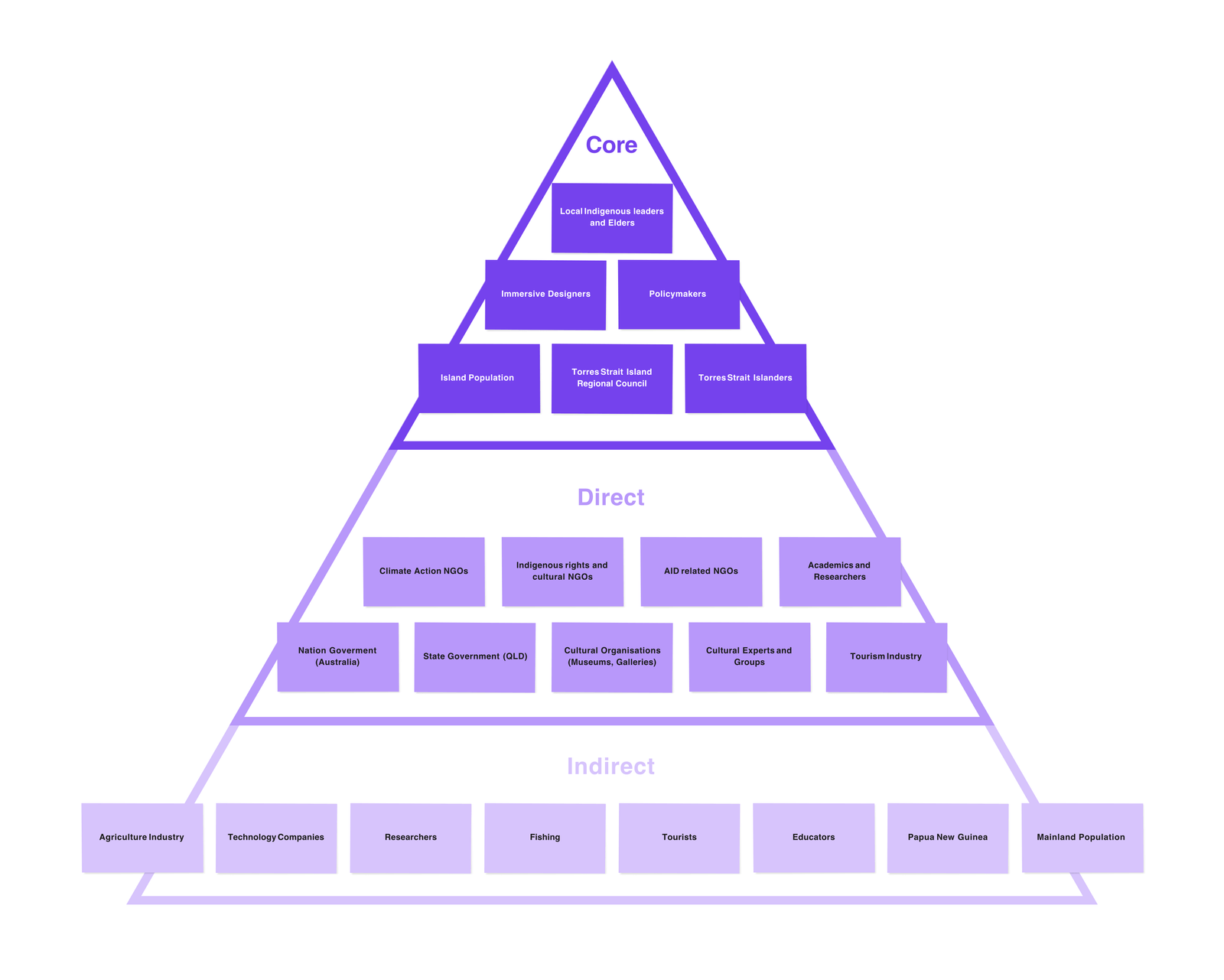
- Medical — general practitioners, pharmacists, testing clinics.
- Educators — teachers, lecturers, community organisations.
- Cultural — queer venues, pride events, faith-based groups, cultural institutions and leaders.
- Political — local, state and federal government.
- And people living with HIV.
Using design research to find a way in
So the logical question is how we can use design to increase the uptake of PrEP and help eliminate the spread of HIV in Australia. How can we use design research methods to understand the problem space and uncover a path to a functional and viable solution?
Working in a field like HIV requires acknowledging the decades of research and effort that produced the current level of knowledge. Australia has been rather privileged in its proactive approach in recent years, and there is already a lot of high-quality data available. But understanding the current state of the community’s understanding of HIV and PrEP is important as a foundation — as is understanding the wider general public’s awareness.
We can gather mass quantitative data, including online surveys. But we also need a large and diverse dataset from urban and regional areas, which means going out to community venues.
Then interviews with people in and around particular groups of interest: Aboriginal and Torres Strait Islander communities, people born overseas, members in and around fundamentalist religious groups, patrons of queer spaces such as gay bars and sex clubs. Each of these contains members particularly susceptible to HIV and to the complexities around prevention. As an example, AFAO found HIV diagnosis among Aboriginal and Torres Strait Islander communities is around 1.3 to 1.9 times higher than among Australian-born non-Indigenous people — in part due to the neglect of adequate medical care in regional areas, and access to education.
Alongside gathering that community knowledge, we need to consult experts in the field to understand where we’d like community understanding to be. With both sets of data we can see how each community’s understanding matches up against expert understanding, and from that see where in the problem space there is the greatest opportunity for harm reduction — then target accordingly. We’ll also be creating different approaches for each community. What works for one won’t necessarily work for the other.
Where immersive technology actually fits
Immersive technology has less of a role in intervening in the problem itself, and more in how we communicate future solutions.
Immersive tech isn’t going to make PrEP cheaper. But it could help tell the story of how cheaper PrEP and better education could change the way we approach sexual health. If we could design a narrative around sexual health that was generative rather than prescriptive, we might all be a lot happier.
There is a lot of room to discuss the risks involved with casual sex, monogamous partnerships and open relationships in a way that doesn’t pit them against each other, but treats them as choices made by reasonably informed adults — a discussion about harm reduction rather than harm elimination through celibacy.
How we talk about sex education is deeply interconnected with how we talk about treating HIV. If we could shift the approach to HIV towards something that considers the wider space of STIs, then we can really build something. Immersive tech is very good at moving people into different contexts and telling compelling stories. If we could leverage that to start systemic change among policymakers, community leaders and educators, we could build a genuinely embedded solution to this wicked problem.
Bias
Coming from a user experience design background, I think that with good data and some Post-it notes I can build anything.
But medicine and healthcare are deeply complicated, expensive and political fields to work within. It is straightforward to say that we need to talk to stakeholders like policymakers at local, state and federal levels — what that actually means is bringing in enormous amounts of conflicting perspectives and needs, plus the justification for why we are spending our attention on this particular space of governance. Not that HIV isn’t important, but as a queer person, and because of its history and effect on our community, it carries a far higher sense of urgency and need for action for me personally than it does for the general population.
A particular difficulty in sexual education as a whole is working within culturally and religiously diverse communities. Not to say they are all equally difficult to work within, but abstinence until marriage — or at least the appearance of it — is seen as the only appropriate cultural narrative in a lot of these communities, and that isn’t necessarily a bad thing in itself.
The problem is when those narratives are enforced through a lack of knowledge, education and basic informed choice. Teaching someone how to have safe sex isn’t the same thing as telling someone to go out and have sex — and yet to a lot of people, they are seen as the same thing. That will be really hard to come across and constructively dialogue with. And yet we need those communities on board to provide effective education for all of our students, not just those in the public system.
Bibliography
AFAO. (2021). HIV in Australia 2021.
AFAO. (2022). HIV in Australia 2022.
AFAO. (2023). HIV in Australia 2023.
CDC. (2022, June 6). PrEP effectiveness. Centers for Disease Control and Prevention.
Ending HIV. (n.d.). PrEP HIV prevention: pre-exposure prophylaxis.
Jones, T., & Mitchell, A. (2014). Young people and HIV prevention in Australian schools. AIDS Education and Prevention, 26(3), 224–233.